
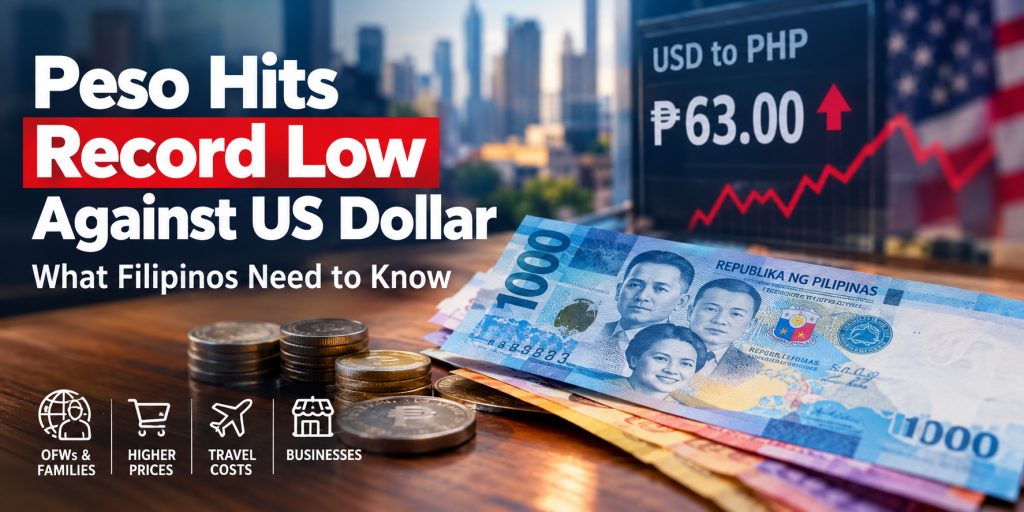
A Weaker Peso Is More Than Just a Currency Story
Every time the Philippine peso loses ground against the US dollar, the effects can reach far beyond the financial markets. For some Filipino families, it could mean receiving more pesos from relatives working abroad. For others, it could mean spending more on fuel, imported products, or a long-planned trip overseas.
That is what makes the peso hitting a record low against the US dollar more than just another headline about the economy. Exchange rate movements can influence household budgets, business expenses, and the purchasing power of ordinary Filipinos.
But there is an important distinction: a weaker peso does not automatically mean every Filipino will feel the same impact. Some may benefit from the exchange rate, while others could find their money no longer goes as far as it used to.
So, what is driving the peso’s movement, and what should Filipinos understand before making financial decisions?
Why Is the Philippine Peso Losing Value Against the Dollar?
There is rarely one single reason a currency weakens. The peso’s performance against the US dollar reflects a combination of global market conditions, interest rate expectations, demand for foreign currency, and investor confidence.
Here are some of the key factors that can put pressure on the Philippine peso.
1. The US Dollar Remains a Major Force in Global Markets
The US dollar plays a central role in international trade and finance. When investors expect the US economy to perform strongly, anticipate higher interest rates, or seek relatively safer assets during periods of uncertainty, demand for dollars may increase.
When that happens, emerging-market currencies such as the Philippine peso can face additional pressure.
However, the dollar does not move in isolation. The peso’s own performance also depends on domestic economic conditions and developments across global markets.
2. Interest Rates Can Influence Where Money Flows
Investors consider potential returns when deciding where to place their money. If US interest rates are more attractive relative to Philippine rates, some investors may prefer dollar-denominated assets.
That can increase demand for dollars and affect the peso-dollar exchange rate.
Still, interest rate differences are only part of the picture. Inflation expectations, economic growth, market confidence, and anticipated policy decisions can also influence investment flows.
3. The Philippines’ Dependence on Imports Matters
The Philippines imports essential goods, including petroleum products, machinery, and industrial materials. Many international transactions are priced in US dollars, meaning local businesses often need dollars to pay foreign suppliers.
When the dollar becomes more expensive in peso terms, importing the same quantity of goods can cost more.
For example, an importer who needs to pay a US supplier $10,000 will have to spend more pesos if the exchange rate rises from ₱58 to ₱63 per dollar. That is an additional ₱50,000 before fees and other expenses.
The exchange rate alone does not determine the final price consumers pay, but it can add pressure to business costs.
4. Global Uncertainty Can Shift Investor Sentiment
Oil price movements, geopolitical tensions, and concerns about the global economy can influence currency markets.
During periods of uncertainty, investors may increase their holdings of US dollars. Depending on the circumstances, that shift can weaken currencies in other markets, including the peso.
These movements can change quickly, which is why a single day’s exchange rate does not always tell the full story.
What a Weaker Peso Means for Filipino Households
For many Filipinos, the most important question is not what happens on a currency trading screen. It is how much money they will have left after paying for everyday needs.
The answer depends on whether a person earns in pesos, receives money from abroad, buys imported products, or runs a business that relies on foreign suppliers.
OFWs and Their Families Could Receive More Pesos
For families receiving remittances in US dollars, a weaker peso can offer a financial advantage.
Consider an overseas Filipino worker sending $500 to relatives in the Philippines.
At an exchange rate of ₱58 per dollar, the amount converts to ₱29,000. At ₱63 per dollar, the same $500 converts to ₱31,500.
That is a difference of ₱2,500 before transfer fees and differences in provider exchange rates.
But the benefit is not the same for every OFW. Workers earning in currencies other than the US dollar may see different results, depending on how their earnings are converted. And even when families receive more pesos, higher living costs can reduce what that money can buy.
More pesos do not always mean more purchasing power. That distinction matters when families are trying to cover rent, groceries, school expenses, and other household bills.
Everyday Expenses Could Become More Expensive
A weaker peso can increase the cost of imported goods and materials. Fuel is one important example because petroleum prices and currency movements can influence the peso cost of imported energy.
Businesses that rely on imported ingredients, equipment, packaging, or raw materials may also face higher expenses.
Some companies absorb part of those increases. Others adjust their prices, depending on competition, existing contracts, inventory, and operating costs.
That means a weaker peso does not automatically make every product more expensive overnight. However, if higher import costs persist, they can contribute to inflationary pressure.
For households already working with a tight budget, even gradual price increases can make a difference.
Traveling Abroad May Cost More
Filipinos planning a trip to the United States or another destination where expenses are priced in dollars may need a larger peso budget.
Hotel bookings, shopping, meals, transportation, and other travel expenses can become more costly when converted into pesos.
For example, a $1,000 travel budget would equal ₱58,000 at ₱58 per dollar, compared with ₱63,000 at ₱63 per dollar.
That is an extra ₱5,000 for the same dollar-denominated budget, excluding fees and other changes in travel prices.
Travelers can limit surprises by comparing bank and money changer rates, checking foreign transaction fees, and deciding how much foreign currency they actually need before leaving the country.
Import-Dependent Businesses May Face Tighter Margins
For businesses that pay suppliers in dollars but earn most of their revenue in pesos, a weaker exchange rate can squeeze profit margins.
Small businesses may be particularly sensitive to higher costs if they have limited room to negotiate supplier prices or increase what they charge customers.
Some companies use advance purchasing, pricing adjustments, or currency hedging to manage exchange rate risks. Others have fewer options and must find ways to absorb the added expense.
The result can affect more than business owners. When operating costs rise, companies may reconsider hiring, expansion plans, or product prices.
Exporters and Dollar Earners May Have an Advantage
A weaker peso can work in favor of Philippine businesses that earn US dollars but pay a substantial portion of their expenses in pesos.
When those dollar earnings are converted into pesos, the business may receive more local currency.
However, the advantage is not guaranteed. Companies that import raw materials, pay dollar-denominated debts, or face higher operating costs may see some of the benefit disappear.
In other words, the effect of a weaker peso depends on where a business earns its money and where it spends it.
Will the Peso Continue to Fall Against the US Dollar?
This is the question many people want answered, especially when the exchange rate makes headlines.
The reality is that no one can predict the peso’s next move with certainty.
Its direction may depend on US Federal Reserve policy, the Bangko Sentral ng Pilipinas’ decisions, Philippine economic growth, inflation, capital flows, oil prices, and broader investor sentiment.
A stronger dollar can put pressure on the peso, but changing economic conditions can also support a recovery. Exchange rates can move in either direction as markets respond to new information.
Filipinos should be cautious about predictions that promise a specific exchange rate or claim the peso will inevitably keep falling. A forecast is not a guarantee, and even professional market analysts can get currency movements wrong.
For households, it is often more useful to prepare for possible changes than to try to predict the exact rate.
That could mean reviewing travel budgets, comparing remittance services, or allowing for currency fluctuations when planning expenses involving dollars.
How to Check the Peso-to-Dollar Exchange Rate Today
If you want to know how much one US dollar is worth in Philippine pesos, start with reliable financial sources.
The Bangko Sentral ng Pilipinas (BSP) publishes reference exchange rate information, while reputable financial news organizations report on market movements and developments affecting the peso.
Keep in mind that the published reference rate may not match the rate you receive when exchanging money.
Banks, remittance companies, money changers, and payment platforms can apply different rates and fees. The amount ultimately received depends on the provider and the terms of the transaction.
It is also important to distinguish between an intraday exchange rate and an official closing rate. A currency may reach a particular level during trading without closing at that same level.
If a report says the peso has hit a record low, check the date, the source, and whether the claim refers to an intraday level or a closing rate. Historical records should be verified before describing any movement as an all-time low.
Frequently Asked Questions
The peso can weaken because of stronger demand for the US dollar, changes in interest rate expectations, import-related dollar demand, investment flows, and global economic uncertainty. The main drivers can differ depending on market conditions.
It can be beneficial for OFWs sending US dollars home because their remittances may convert into more pesos. However, the actual benefit depends on transfer fees, the exchange rate offered by the provider, the currency in which they earn, and the cost of living in the Philippines.
It can contribute to inflation by increasing the peso cost of imported fuel, materials, and other goods. The actual effect depends on global prices, domestic supply conditions, business decisions, and how much of the added cost is passed on to consumers.
It can contribute to inflation by increasing the peso cost of imported fuel, materials, and other goods. The actual effect depends on global prices, domestic supply conditions, business decisions, and how much of the added cost is passed on to consumers.
Providers may use different exchange rate margins and fee structures. As a result, the rate displayed in financial news may differ from the rate available for an actual cash exchange, remittance, or card transaction.
A recovery is possible, but it cannot be guaranteed. Changes in monetary policy, economic performance, investor sentiment, and global market conditions can influence the exchange rate in either direction.
The Bottom Line: Watch What the Exchange Rate Means for Your Money
The peso’s movement against the US dollar is not just a story for economists, traders, or investors. It can affect the money families receive from abroad, the cost of imported goods, the budget for an overseas trip, and the expenses businesses face every day.
Some Filipinos may benefit from a weaker peso, particularly those receiving dollar remittances or earning dollar income. Others may feel the pressure through higher costs and tighter household budgets.
What matters most is understanding how the exchange rate affects your own financial situation rather than assuming that a falling peso is entirely good or entirely bad.
Keep an eye on verified exchange rate data, compare the actual rates offered by financial service providers, and be wary of predictions presented as certainties.
The peso-dollar rate may change every day, but informed financial decisions can help Filipinos prepare for those changes. Follow biggerscroll for daily updates.
